


BLUF: The Patient Health Questionnaire (PHQ-9) is CVN’s primary measurement-based care screener, used at each clinical session with all adult clients. These data describe one of the ways this critical tool is used as part of our comprehensive suicide risk management ecosystem to identify suicide risk in real time to optimize client safety.
- Suicidal thoughts are reported at higher rates among US veterans & military members and also among those seeking mental healthcare.
- PHQ-9 is used by CVN clinicians to briefly assess and reassess adult clients at each encounter. It includes item #9 which screens for suicide risk.
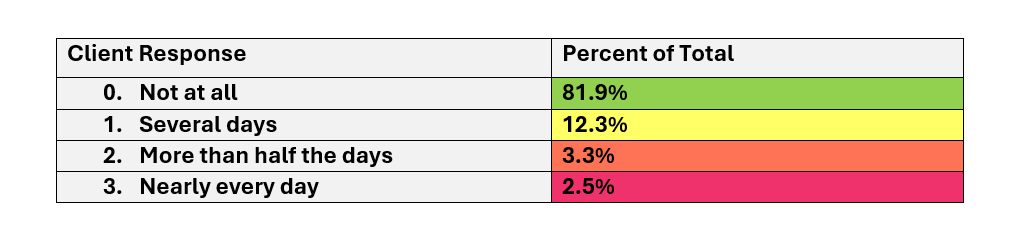
Table 1. PHQ-9 item 9 [“How often you have been bothered by thoughts that you would be better off dead or of hurting yourself in some way”] responses in CVN client data
- Almost 1 in 5 (18.1%) of CVN clients endorsed being bothered by these thoughts for several days or more.
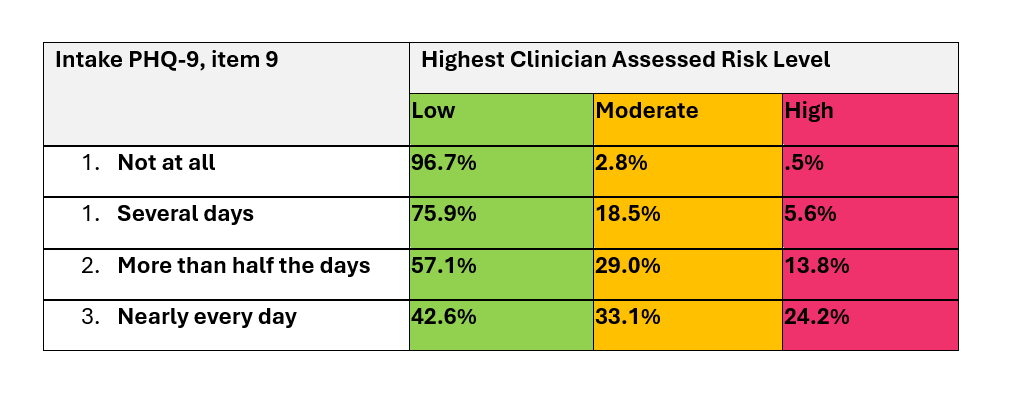
Table 2. Intake PHQ-9 Item 9 response & highest clinician assessed risk level during treatment (2024 & 2025 data)
PHQ-9 item scores are strongly linked with clients being identified as either moderate or high risk, with clients reporting “nearly every day” (3) almost 50x more likely to be assessed as high risk than those endorsing “not at all” (0).
This is important given previous research findings which indicated that these responses are valid predictors of suicidal behavior. Louzon & colleagues (2016) found that,
- A response of “more than half the days” was associated with a 115% increased risk of suicide.
- A response of “nearly every day” was associated with a 185% increased risk of suicide.
- Simon and colleagues (2016) reported rates of suicide death 5-7 times higher among those endorsing “nearly every day ” vs “not at all” over two years.
Together, these findings demonstrate that using the PHQ-9 at intake and each subsequent encounter can play a key role in identifying and supporting military connected clients at increased risk.
References
Kim, S., Lee, H.-K., & Lee, K. (2021). Which PHQ-9 Items Can Effectively Screen for Suicide? Machine Learning Approaches. International Journal of Environmental Research and Public Health, 18(7), 3339. https://doi.org/10.3390/ijerph18073339
Louzon, S. A., Bossarte, R., McCarthy, J. F., & Katz, I. R. (2016). Does Suicidal Ideation as Measured by the PHQ-9 Predict Suicide Among VA Patients?. Psychiatric services (Washington, D.C.), 67(5), 517–522. https://doi.org/10.1176/appi.ps.201500149
Simon, G. E., Coleman, K. J., Rossom, R. C., Beck, A., Oliver, M., Johnson, E., Whiteside, U., Operskalski, B., Penfold, R. B., Shortreed, S. M., & Rutter, C. (2016). Risk of suicide attempt and suicide death following completion of the Patient Health Questionnaire depression module in community practice. The Journal of clinical psychiatry, 77(2), 221–227. https://doi.org/10.4088/JCP.15m09776