
BLUF: Suicide safety plans are most effective when they are personalized, practiced, and revisited over time. Turning coping skills and social engagement / connection into daily habits rather than emergency responses can help manage emotional distress in real time to prevent progression to suicidal crises.
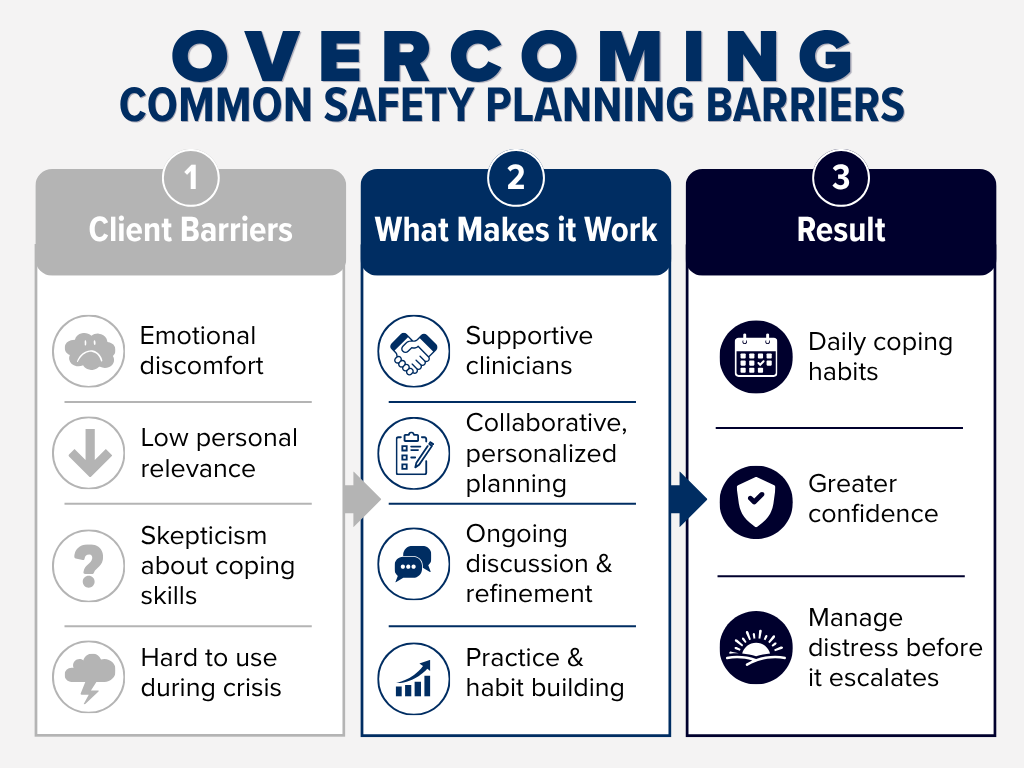
Lessons from CVN research: Safety planning is a cornerstone of suicide prevention for clients at elevated risk, but not all safety planning experiences are equally impactful. Cohen Veterans Network Institute for Quality (CVN-IQ) conducted a qualitative study interviewing former at-risk clients about their experiences with safety planning. Thematic analysis highlighted factors that transformed their safety plans from merely required processes into useful tools to manage suicidal thoughts and behaviors.
Why It Matters
- Safety planning is widely used for suicide prevention in healthcare settings
- Research suggests that common barriers affect how clients use & value their safety plans over time
- Understanding client perspectives is key to improving safety planning effectiveness
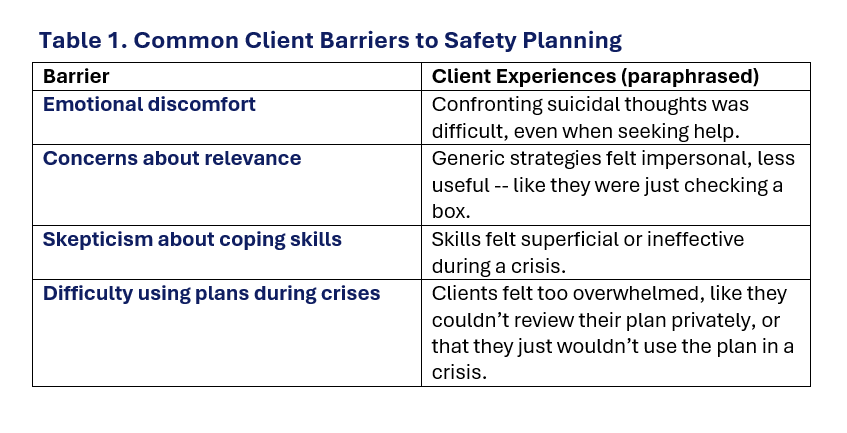
Key Findings: Common barriers identified in this study and supported by published research may impact safety plan engagement (Brousseau-Paradis et al., 2025; Kayman et al., 2015; O’Connor et al., 2022; Stanley et al., 2016). Importantly, our study reveals that even among treatment-seeking clients, safety planning often began with hesitancy and uncertainty about whether the plan would be effective.
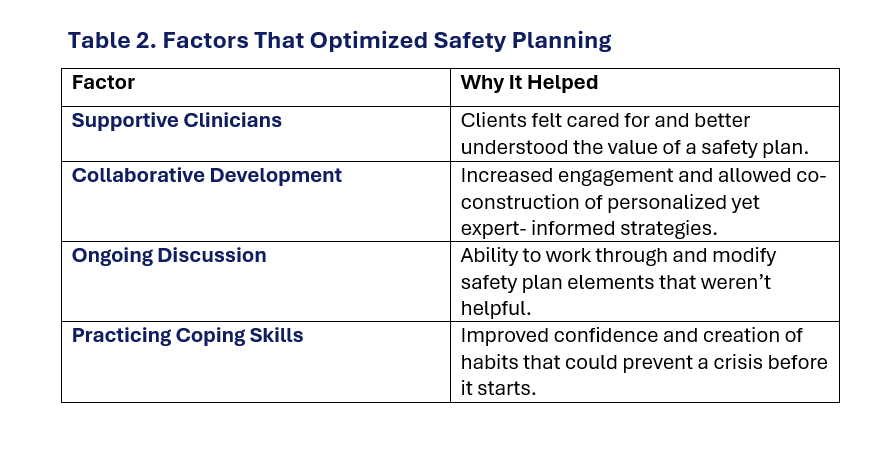
Key Take-Away: Previous research found that clients struggle to implement coping strategies during periods of acute emotional distress. Participants reported greater confidence using skills that had been discussed, refined, and rehearsed with their clinician rather than simply documented on a plan.
CVN network data. Findings may not be representative of other populations or care settings.
References:
Brousseau-Paradis, C., Genest, C., Maltais, N., Séguin, M., & Rassy, J. (2025). Towards a better use of safety planning in emergency departments: an exploratory study of patients and clinicians’ perspectives. Community Mental Health Journal, 61(4), 724-733.
Kayman, D. J., Goldstein, M. F., Dixon, L., & Goodman, M. (2015). Perspectives of suicidal veterans on safety planning: Findings from a pilot study. Crisis: The journal of crisis intervention and suicide prevention, 36(5), 371.
O’Connor, R. C., Smillie, S., McClelland, H., Lundy, J. M., Stewart, C., Syrett, S., … & Simpson, S. A. (2022). SAFETEL: a pilot randomised controlled trial to assess the feasibility and acceptability of a safety planning and telephone follow-up intervention to reduce suicidal behaviour. Pilot and feasibility studies, 8(1), 156.
Stanley, B., Chaudhury, S. R., Chesin, M., Pontoski, K., Bush, A. M., Knox, K. L., & Brown, G. K. (2016). An emergency department intervention and follow-up to reduce suicide risk in the VA: Acceptability and effectiveness. Psychiatric services, 67(6), 680-683.