


What Are Social Determinants of Health?
Social Determinants of Health (SDoH), also known as social drivers of health or social risks, are the non-medical factors that influence health outcomes. They are the conditions in which people are born, grow, work, live, and age, and the wider set of forces and systems shaping the conditions of daily life (World Health Organization.). SDoH include factors such as unemployment, insecure housing, legal involvement and lack of social support.
How Social Determinants of Health Influence Suicide Risk
SDoH have been shown to adversely impact both mental health outcomes and suicide risk across populations, including U.S. military members and veterans. Our CVN data offer additional insight into these challenges and their implications for military community mental health care.
Key Findings from CVN Data
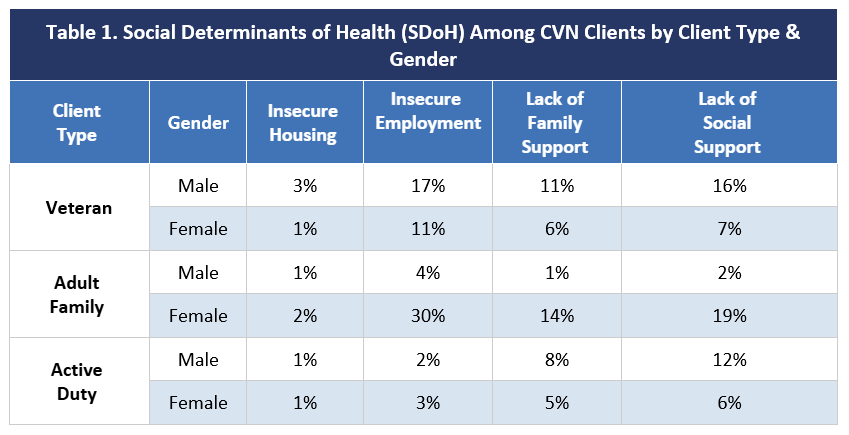
- SDoH are implicated in influencing health (including mental health) status & outcomes in military community members.
- In CVN data, male veterans & female adult family members report significantly higher rates of SDoH in key areas (see Table 1.).
- This is consistent with data on military & veteran spouse underemployment & underemployment (Maury et al. 2025) as well as social challenges including loneliness among veterans (Wilson et al., 2018).
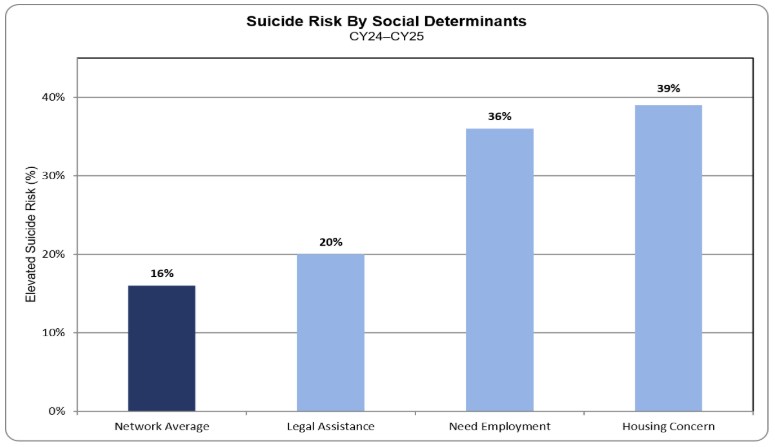
Figure 1. Percent of clients identified as at clinically elevated suicide risk
Housing and Employment as Primary Risk Drivers
- Housing and employment needs showed the strongest individual association with elevated suicide risk. Clients reporting housing concerns (39%) or employment needs (36%) had elevated risk rates that were more than double the network rate among adult clients (16%). (See Figure 1.)
- Legal assistance needs were also associated with higher risk, though the increase was more modest (20%). This suggests that social determinants broadly associated with clinician assessed suicide risk with varied levels of magnitude in CVN clients.
Clinical Risk and SDoH (CVN Data)
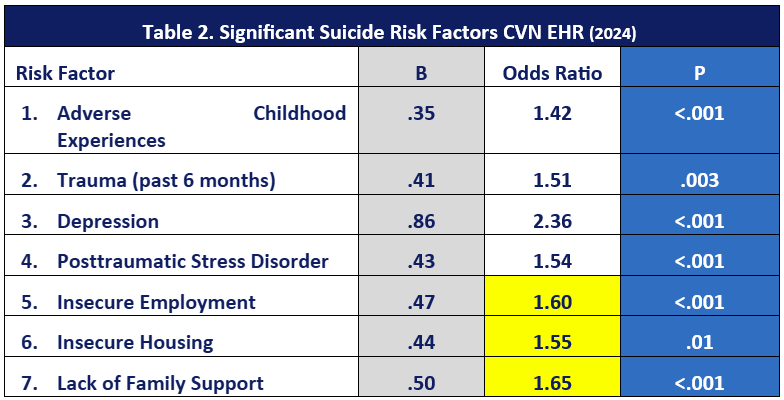
- In previous analyses of CVN data, SDoH were found to be among the strongest predictors of elevated risk status in adult clients along with other factors including trauma history and diagnoses, i.e., PTSD & depression. (See Table 2.).
- Note: Odds ratios greater than 1 indicate increased likelihood of elevated risk status for those endorsing those SDoH. In this case, 55%-65% higher for the three SDoH highlighted in yellow.
- The presence of multiple social risks (2 or more) was also associated with worse treatment outcomes and higher drop-out from care in CVN clients.
- This replicates findings in other published studies. Pietrzak & colleagues (2025) in a nationally representative sample of US veterans found that those with the highest SDoH burden were 20x more likely to report suicidal thoughts and behaviors than those with the lowest SDoH scores.
Relevance & Application to Military & Veteran Mental Health Care
- Clinicians can benefit by understanding the role of social determinants influencing treatment outcomes & suicide risk in military affiliated clients.
- SDoH are a key part of CVN’s biopsychosocial assessment and allow at-risk clients to be identified & placed on CVN’s risk management pathway.
- CVN is able to engage their case managers assigned at each clinic who directly address social determinants through their work with clients.
- Continued research in SDoH is essential to address both military mental health and the substantially elevated suicide risk among military & veteran populations.
CVN network data. Findings may not be representative of other populations or care settings.
References:
Maury, R. V., Roman, J. L. R., Stone, B., & Harvie, J. Y. (2025). Military spouse employment landscape: Trends, barriers, and opportunities.
Pietrzak RH, Fischer IC, Nichter B, et al. Social Determinants of Health and Suicide Risk in US Military Veterans. JAMA Psychiatry. 2026;83(3):315–318. doi:10.1001/jamapsychiatry.2025.3883
G Wilson, M Hill, M D Kiernan, Loneliness and social isolation of military veterans: systematic narrative review, Occupational Medicine, Volume 68, Issue 9, December 2018, Pages 600–609, https://doi.org/10.1093/occmed/kqy160